What to Know Before Moving to Jacksonville, FL: 15 Real Facts
15 Things You NEED TO KNOW Before Moving to Jacksonville, Florida
Prefer to watch? The full breakdown is above — the written version is below.
A call came into our office recently from someone thinking about moving here. They had been watching our videos, and the message was, more or less: put me on with the guy from the videos, I want him to convince me to move to Jacksonville.
We laughed, because we are the worst people to call for that. We sell houses, obviously. But the job is not to convince you Jacksonville is the greatest place on earth, because it is not, and depending on what you want it might be a terrible fit. We are fine saying that out loud.
Our job is to help you understand Jacksonville — the good, the expensive, the humid, and the occasional Florida man on a four-wheeler on the highway. Then you decide.
The short answer: Jacksonville is not one place. It is roughly 875 square miles counting water, about 747 square miles of land, consolidated with Duval County in 1968 — and four buyers with the same $500,000 budget will be shopping four different markets depending on the county. Before you move here you need to understand the four-county price spread, the money that shows up after the mortgage (property taxes reassessed at your purchase price, homeowners insurance driven by the age of the house, CDD fees, utilities), and the fact that your ZIP code will decide your daily rhythm more than your address will.
How big is Jacksonville, really?
Big enough that this is not trivia. Jacksonville covers roughly 875 square miles including water — about 747 square miles of land, the largest city by land area in the contiguous United States — after the 1968 consolidation with Duval County.
So moving to Jacksonville is not one decision. It is picking from a dozen places that share a name and almost nothing else. Riverside with its brick streets and 1920s bungalows is Jacksonville. The beaches are Jacksonville. The rural Northside is Jacksonville. And Nocatee, the master-planned community with the water park you have already looked up, is not even in Duval County.
When somebody says "we want to live in Jacksonville," our first thought is: which Jacksonville?
What do homes cost in Duval, St. Johns, Clay and Nassau?
That median price you already Googled can be accurate and completely useless at the same time.
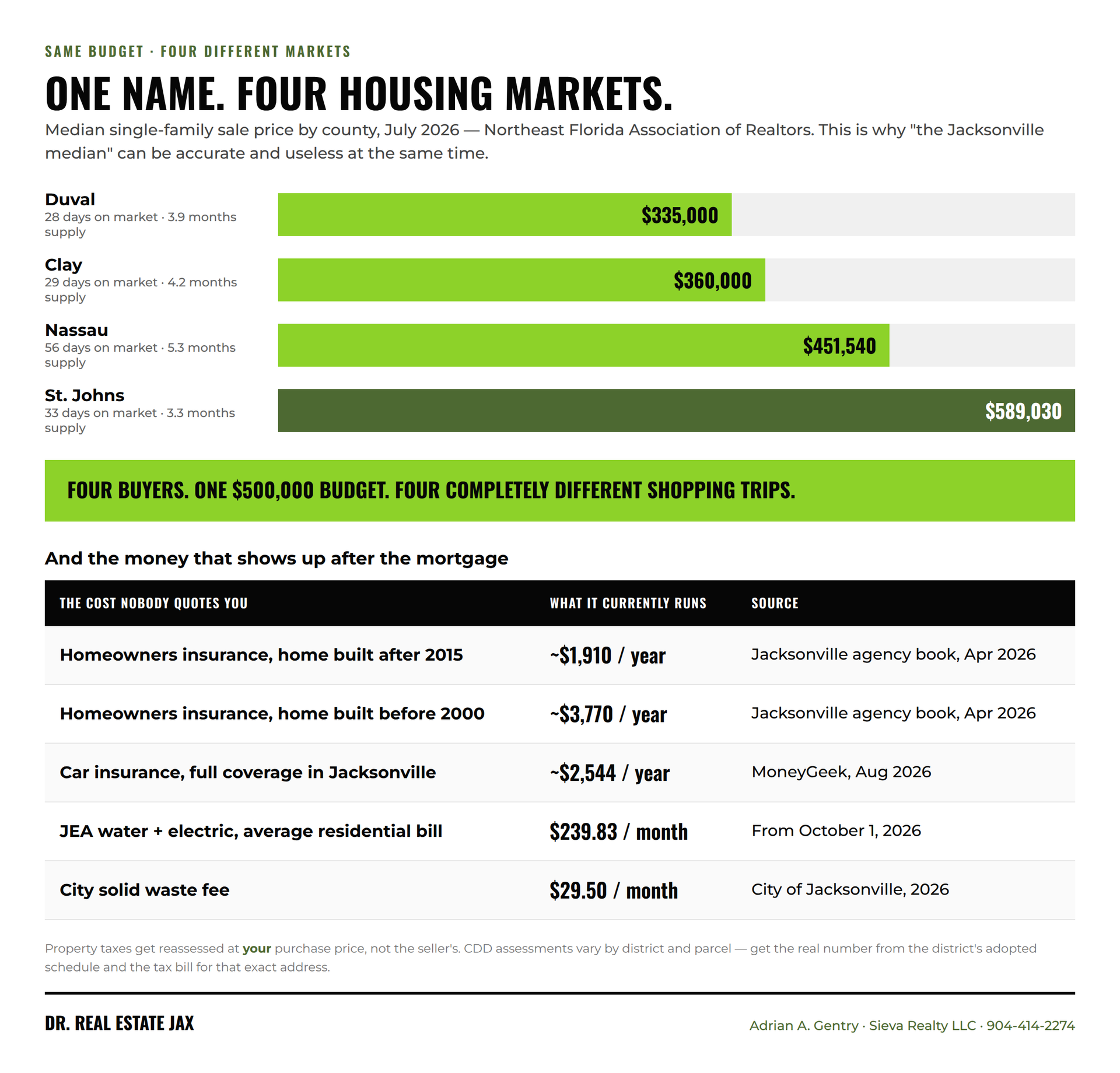
Per the Northeast Florida Association of Realtors, in July 2026 the single-family median sale price was $335,000 in Duval, $360,000 in Clay, $451,540 in Nassau and $589,030 in St. Johns. The six-county region came in at $405,000, with a median 30 days on market and 3.9 months of supply.
Four buyers, same $500,000 budget, four completely different shopping experiences. That is why we do not start with how much house you can get. We start with what kind of life you are trying to have — and then figure out where $500,000 buys it.
The good news is this is not 2021. There is more inventory, homes are sitting longer, and buyers have some room to negotiate. You have time to figure out which Jacksonville works for you.
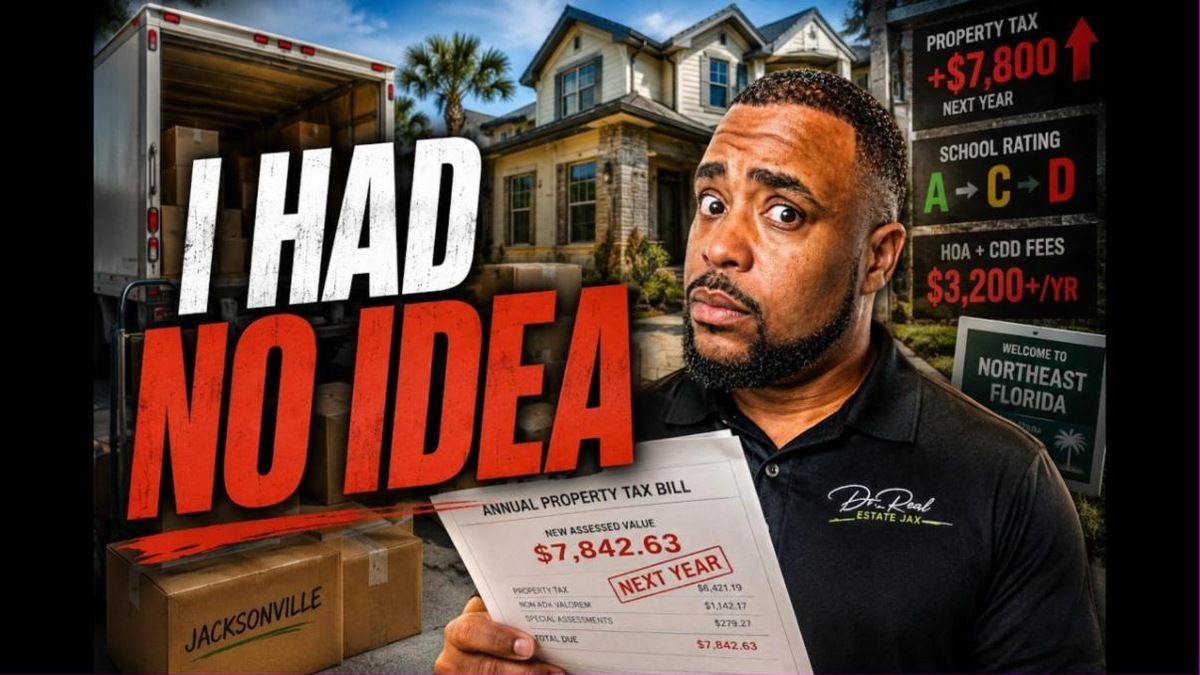
Will my property taxes go up when I buy in Florida?
Almost certainly, and this is the one that catches people.
Florida has Save Our Homes, which caps how fast the assessed value can rise on a homesteaded property. So if somebody has owned and homesteaded a house for years, their assessed value can sit far below what the house is actually worth today. Then you buy it, and it gets reassessed.
You look at a listing and think, look at that, taxes are only $1,900 a year. No. Those were Bobby's taxes. Bobby bought that house 12 years ago and Bobby is over there minding his own business, cutting his grass, enjoying his homestead exemption. You do not get Bobby's taxes.
Estimate what you would pay based on your purchase price. That is the number that matters.
How much is homeowners insurance in Jacksonville?
We have an advantage over South Florida and the Gulf coast. It is still Florida, and the insurance company will find a way to remind you.
Here is the part that no one really explains: the age of the house drives the premium more than the price of the house does. One Jacksonville agency's analysis of more than 2,000 of its own HO-3 policies, published in April 2026, put the average annual premium at roughly $1,910 for homes built after 2015, about $2,895 for homes built 2000 to 2014, and around $3,770 for homes built before 2000.
That is one agency's own book of business at a fairly high coverage level, not a state filing — but it is one of the only sources that breaks Jacksonville out by year built, and the direction of it matches what we see in the field every week.
The roof can change everything. So get your insurance quote during the inspection period. Not three days before closing, when your mom knows the address and the kids have picked bedrooms and somebody finally says nobody wants to insure that roof.
What are CDD fees, and do they ever go away?
If you are looking at newer master-planned communities you will hear this a lot. CDD stands for Community Development District. The community needed infrastructure and amenities, somebody had to pay for it, and congratulations — you are now part of the payment plan. It is usually collected with your property tax bill, on top of your HOA.
We are not going to publish an "average Jacksonville CDD fee," because the amount depends entirely on your district, your neighborhood and your specific parcel, and the ranges floating around online disagree wildly. Ask for the real number three ways: the listing's association and assessment section, the district's own adopted assessment schedule for your village, and the non-ad valorem line on the current tax bill for that exact address.
And when somebody tells you the CDD eventually goes away, ask which part. The bond portion can be paid off. The maintenance portion keeps going.
CDDs are not automatically bad, by the way. If your family is in the pool, on the trails and at the park every weekend, you are getting your money's worth. If your relationship with the amenity center is waving at it through the windshield, that is a different conversation. We are not anti-CDD. We are anti-paying for something you do not use.
What salary do you need to live in Jacksonville?
We hate this question, and not because it is a bad one. Everybody's definition of comfortable is different. One person means the bills are paid, we eat out sometimes, we take a vacation. Somebody else means four bedrooms, private school, three vacations, and I do not cook on Fridays. Sir, you do not need a cost of living calculator. You need a raise.
So here are actual numbers. Jacksonville's median household income is about $69,872 against roughly $80,734 nationally, per Census figures for 2020–2024. The MIT Living Wage Calculator, updated February 2026, puts the after-tax cost of the basics in Duval County at about $39,621 for a single adult and about $95,293 for two working adults with two children. That is basics. Lights on, doing all right.
If you are bringing a remote job, transferring with a company, coming in on military orders or retiring here, the math tends to work. If your plan is to find the same job at the same salary after you arrive, check that before you pack the truck.
Plan Your Jacksonville Move Around Your Lifestyle
Book a relocation consultation to match your budget, lifestyle, schools, builders, and ideal Northeast Florida community.
Is Florida's no state income tax actually worth it?
It is real money. Just count everything else too.
Florida is basically saying we will not tax your income — and then the insurance company comes around the corner like, hey, big fella.
Car insurance: Florida runs well above the national average. Insurify put Florida full coverage at about $2,839 a year against $2,241 nationally as of August 2026 — roughly 27% higher. MoneyGeek put Jacksonville full coverage at about $2,544 a year. And you are going to drive a lot here. People tell us they want to live in St. Johns, work near the airport, and be close to the beaches. Okay. So you enjoy driving. We just learned something about you.
Utilities: JEA approved an 8.2% residential electric increase and a 6% residential water increase effective October 1, 2026, taking the average combined residential water and electric bill from about $231.67 to about $239.83 a month. The City of Jacksonville residential solid waste fee is $29.50 a month for 2026, billed on your property tax bill.
And the house itself matters, because your air conditioner is not decorative. From April to October it has a job. By August it owns the house and you are just helping with the mortgage. An older home with tired insulation and an HVAC system that has been fighting since the Bush administration costs very differently than new construction.
So do not ask what your mortgage payment is. Ask what your life costs here.
Does Jacksonville get hurricanes?
The minute you mention moving to Florida, somebody — usually a person who spends Saturday morning digging their car out of six inches of snow — is going to bring up hurricanes. Everybody chooses their struggles.
Jacksonville has not taken a direct hit from a major hurricane in decades, and we sit in a different position than South Florida or the Gulf coast. But here is the important part: a hurricane does not have to hit Jacksonville for parts of Jacksonville to flood. Irma proved that in 2017. Per the National Hurricane Center's report, Irma's center passed between Tampa and Orlando — well west of us — and the St. Johns River still peaked at 5.3 feet above mean higher high water at the I-295 bridge gauge, with major flooding in the Jacksonville area.
A big reason is the river itself. It is huge, it is slow-moving, and it flows north, because apparently even our river looked at the rest of America and decided to do its own thing.
What we want relocating buyers to understand is that flood risk here is extremely location-specific. A large amount of Jacksonville sits outside FEMA's high-risk special flood hazard areas. So do not hear "Florida" and picture the couch floating down the street — but do check the flood designation on the specific property, ask whether it has flooded before, and decide whether carrying flood coverage makes sense even if your lender does not require it.
Homeowners insurance generally does not cover flooding. That is a separate policy, and it is not something to discover while standing in your living room in swim trunks.
How hot does summer actually get?
Summer here does not visit for three months. It moves in, unpacks, and changes its mailing address.
Per NOAA's 1991–2020 climate normals, the average high at Jacksonville International is 91.9°F in July and 90.8°F in August. But the temperature is not what gets you. It is the humidity. Low 90s here can feel like somebody wrapped you in a warm wet towel. You leave the house looking good and by the time you reach the car the whole process starts over.
The payoff is the other side of the year. The January average high is 65.5°F. No shoveling, no scraping ice off the windshield at 7 a.m. while trying to get the kids to school. Every February somebody in Buffalo is watching our videos while we are outside in a quarter-zip, and they hate us a little.
How are the schools in Northeast Florida?
We still hear "I heard Duval County has terrible schools," and our answer is the same as always: which schools?
Per the Florida Department of Education's 2025–26 school grades, all four counties earned an A district grade. St. Johns ranked first in the state with 910 points and 98% of its graded schools at an A or B. Nassau ranked second with 892 points and 100% of its graded schools at an A or B. Clay moved up from a B to an A this year, with 96% of its schools at an A or B. Duval held the A it earned in 2025 — its first in more than 20 years — with 60% of its graded schools at an A or B.
Here is where relocation families get caught. Do not buy the county. Check the schools your specific address is assigned to. You can love the elementary school and have an entirely different conversation about the middle school, and by high school you may want to throw the whole plan out. Moving a few streets can change the zoning. Look at the actual school, look at the programs, visit if you can, and decide what works for your child — not what a green number on a listing site told you.
Who actually employs people in Jacksonville?
If you are coming from Austin or the Bay Area expecting a massive tech scene, our economy is more practical than that. Healthcare, military and logistics.
Baptist Health employs more than 15,000 team members. Mayo Clinic, UF Health and HCA Florida add thousands more. On the defense side, the City of Jacksonville reports military activity supports about 68,060 jobs in Duval County — roughly 17% of the county economy — between NAS Jacksonville, Naval Station Mayport and the broader footprint. Then JAXPORT, rail, interstate, warehousing and distribution. Basically, if America ordered something, Jacksonville probably touched the box.
We like that about this economy. It is not riding one shiny industry. Are there tech jobs? Yes. Is this Raleigh or Austin? No. A lot of the tech people we have relocated brought the job with them — bigger-city salary, Jacksonville housing costs. We will take that trade any day.
Is Jacksonville growing too fast?
The city crossed a million residents — the Census estimate for July 2025 was 1,017,689 — and the surrounding region keeps adding people.
Growth has a trade-off. More development means more opportunity while roads, housing and infrastructure try to keep up. And that is the last thing we want you to understand: you are not only deciding whether to move to Jacksonville today. You are making a call on what this place is going to be in 5, 10 or 15 years. Personally, that is the most interesting thing about being here right now.
Our take
Fifteen facts later, back to that phone call. Convince me to move here. Hopefully now you see why we do not do that.
If you hate heat, we covered that. If you hate driving, we need to talk. And if you want every neighborhood to look the same, cost the same and hand you the same lifestyle, this is not the place. But that is also exactly what people love about it. You have options. Beach life, historic streets, new construction, a little land if you go further out, master-planned communities, or somewhere your neighbors have no idea what you are doing — which, depending on the neighbors, is the greatest amenity of all.
So do not ask whether Jacksonville is a good place to live. Ask whether it is a good place to live for you. If you want help answering that with real numbers instead of vibes, that is the whole job.
Two places to go deeper: what the market actually looks like right now, and what locals really think about living here. If you are coming in on orders, the Florida veteran benefits post is the one to read first.
If you're thinking about relocating to Jacksonville or anywhere in Northeast Florida—or you're ready to buy or sell a home—we'd love the opportunity to help.
Our team specializes in making the entire process as smooth and stress-free as possible, whether you're moving from across the country or just across town.
Give us a call, send us a text, or schedule a Zoom consultation, and let's create a game plan that's built around your goals.
Call or text 904-414-2274
Market figures are from the Northeast Florida Association of Realtors July 2026 release. Income figures are US Census, 2020–2024 five-year estimates. Living wage figures are the MIT Living Wage Calculator for Duval County, updated February 2026. Climate normals are NOAA 1991–2020. School grades are the Florida Department of Education 2025–26 results.
Dr. Real Estate Jax Team
Whether you’re buying your first home or relocating to a luxury estate, I provide a personalized, stress-free experience that’s designed around your needs.

Recent Posts