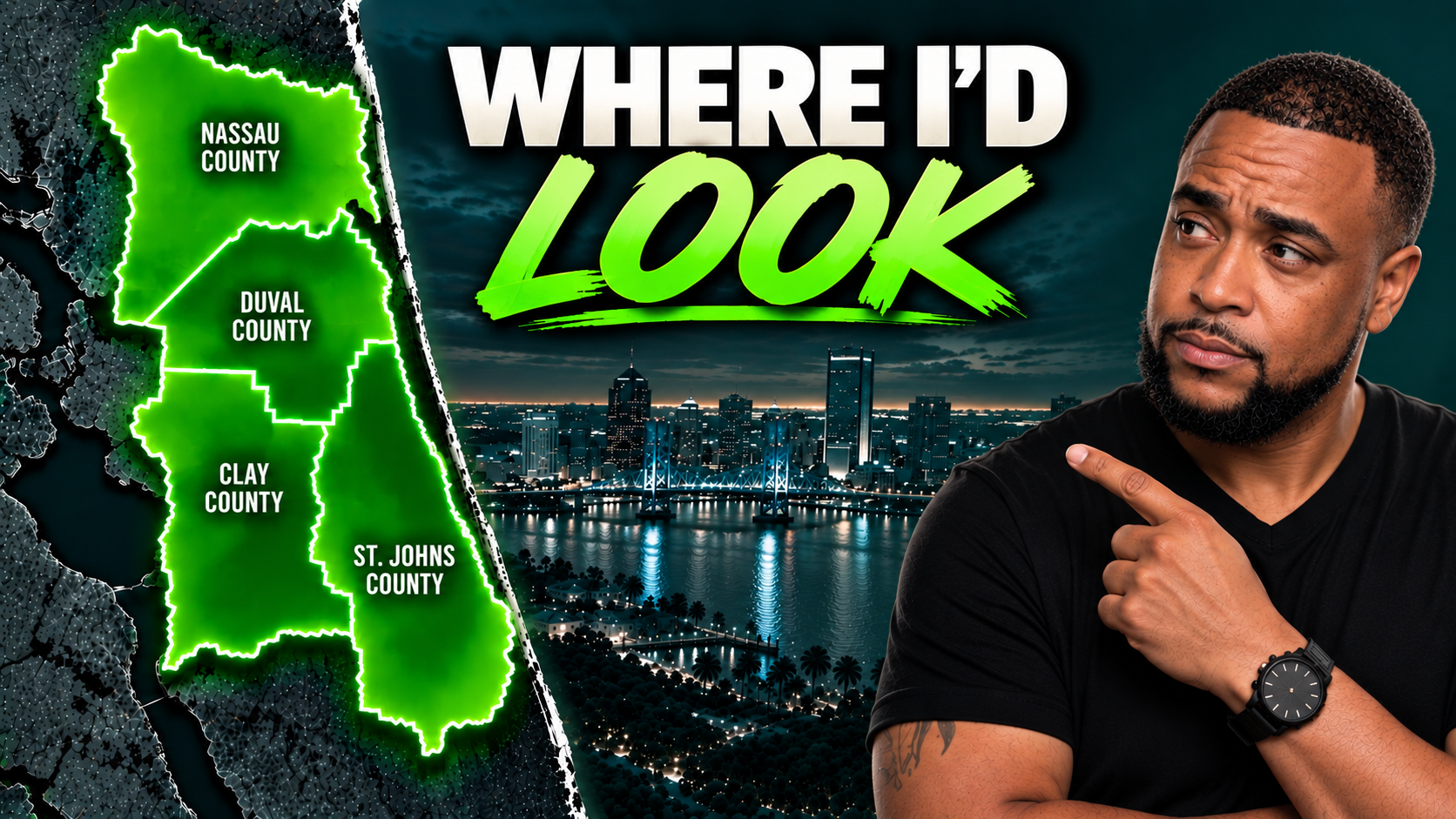
Prefer to watch? The full video is on our YouTube channel: Is Now a Good Time to Buy a House in Jacksonville, Florida?. The written version is below.
This one is for everyone who has spent the last couple of years with Zillow open in one tab and a mortgage calculator in the other, waiting for rates to come down. You kept hearing they were coming down, so you waited. Then you waited a little longer.
Then, instead of coming down, the 30-year fixed crossed 7%.
We're not going to tell you where rates go next, because nobody knows. And "now is a good time to buy" belongs on a billboard, not in a conversation about your money. What we can do is show you who this rate squeezes, who it barely touches, and what the Jacksonville market puts on the table for a buyer right now.
The short answer: it depends on your payment, your timeline and your cushion, not the headline rate. A 7% rate hits hardest on buyers financing most of the price. Buyers bringing equity from a higher-priced market feel it far less. Either way, Jacksonville is a balanced market with real pockets of leverage, especially with builders and homes that have been sitting.
What are mortgage rates in Jacksonville right now?
According to Freddie Mac, the national average 30-year fixed rate was 7.03% on September 24, 2026, the first time its weekly number topped 7% in more than a year. A week earlier it was 6.95%, and a year earlier it was about 6.3%. Mortgage News Daily, which tracks rates day by day, had it at 7.45% the same day.
One thing that confuses a lot of people: on September 16, the Federal Reserve raised its benchmark rate by a quarter point, to a range of 3.75% to 4%. But the Fed doesn't set your mortgage rate. Your 30-year rate follows the bond market, and it often moves before the Fed says a word. Treat these numbers like a weather report, not your quote. Your rate depends on your credit, your loan and your lender.
How much does a 7% rate add to a monthly payment?
Here's the math on principal and interest only, before taxes, insurance, mortgage insurance, HOA or CDD fees:
- A $200,000 loan at 7% is about $1,330 a month.
- A $400,000 loan at 7% is about $2,660 a month.
- On that $400,000 loan, last week's move from 6.95% to 7.03% is about $21 a month. Annoying, but survivable.
- The move from a year ago, 6.3% to 7.03%, is about $193 a month. That one you feel every month for the life of the loan.
Who does a 7% mortgage rate hurt the most?
The rate hits hardest on the buyer who has to borrow the most compared to the price of the house. That's often a first-time buyer with 3% or 5% down, financing almost the whole house and paying mortgage insurance on top. If your budget was already stretched at 6.3%, that $193 a month isn't a rounding error. It can be the difference between the house you want and the house you qualify for.
And plainly: don't buy a house that only works if you refinance next year. "Marry the house, date the rate" leaves out that refinancing costs money, you have to qualify again, and nobody can promise the lower rate is coming. A refinance is a possibility, not a plan.
Does the rate matter if you're bringing equity from another market?
Much less. Say two buyers want the same $400,000 house. Buyer 1 finances all $400,000. Buyer 2 sold a home in a higher-priced market and puts $200,000 down. Compared with a year ago, buyer 1's payment is up about $193 a month. Buyer 2's is up about $97. For a cash buyer, 7% is a headline, not a bill.
For that buyer, supply and negotiation decide the deal, not the rate. The trap is coming from a market where $400,000 buys a condo, landing here, and treating every house like a bargain. Your equity is a head start. It's not a license to overpay.
Plan Your Jacksonville Move Around Your Lifestyle
Get help matching the right neighborhood, budget, commute and social lifestyle before you make a move.
Schedule a Consultation
Is Jacksonville a buyer's or seller's market right now?
Neither, really. According to the Northeast Florida Association of REALTORS, the region had about 3.6 months of single-family supply in August 2026, a median sale price around $397,000 (down about 1.6% from July), and a median of 31 days on market. Realtor.com's August data showed Jacksonville active listings down 16.9% from a year earlier, with 24.3% of listings carrying a price cut.
Translation: a balanced market with real pockets of leverage, not a clearance sale. And those pockets depend on where you stand:
- Duval:
median about $335,000, homes selling in about 25 days.
- Clay:
median about $369,000, with about 4 months of supply, the most of the 4 counties.
- St. Johns:
median about $573,000, with homes taking about 40 days.
- Nassau:
median about $456,000 and about 45 days.
A buyer looking at a St. Johns home that's sat for 60 days is having a very different conversation than a buyer in Duval chasing a well-priced house that hit the market Thursday.
Are sellers paying closing costs in Jacksonville?
Often, yes, and that's usually where leverage shows up, not as a lower list price. Nationally, Redfin found sellers gave concessions on about 44.7% of purchases in the 3 months ending in August. Jacksonville isn't broken out in that report, so don't read it as a promise, but negotiation is clearly happening.
A concession can go toward closing costs, prepaids, repairs or a rate buydown. On a $400,000 house, 3% is $12,000. How much you can take depends on your loan type, since FHA, VA and conventional loans have different limits, and the lender has to approve it. Where it goes matters: $10,000 off a $400,000 loan at 7.03% lowers the payment by about $67 a month, while the same $10,000 toward closing costs and a rate buydown can do more on day one, depending on your loan.
Look at the other side of the table, too. A seller who financed $380,000 at 5.5% 4 years ago still owes about $358,000. If the home is worth $420,000 and selling costs run around 7%, they walk away with roughly $33,000 before repairs or moving. Ask for $30,000 off plus closing costs and a new roof, and they may decide they love living there. Real leverage lives in homes that have been sitting, vacant homes, homes that fell out of contract, and sellers with a real deadline.
Are builders offering rate buydowns in Jacksonville?
The seller who is always on a deadline is the builder. In September, the National Association of Home Builders reported that 66% of builders nationally were using sales incentives and about 38% were cutting prices. Finished homes sitting empty cost builders money every month, so many would rather buy down your rate than cut the price on the sign.
Here's what that looked like with a client recently. Two homes at almost the same price, around $550,000. On the resale, a well-qualified buyer's rate came in at 7.65%, for a payment of about $4,765 a month. The new construction home came with a builder rate of 5.5%, for about $3,980. Same price range, about $785 a month apart, or about $9,420 a year.
Read the fine print. The rate usually requires the builder's lender, it usually applies to inventory homes with a closing deadline, and a temporary buydown lasts a year or two, not 30. A low rate on the wrong house is still the wrong house.
Should you wait for mortgage rates to drop?
Never buy a house you aren't comfortable affording today. But waiting for a rate nobody has promised isn't a strategy, it's hope. Rates could fall, hold or rise. What we do know is that when rates drop enough to bring buyers back, they bring competition, and today's concessions and builder incentives tend to shrink.
There's a calendar piece too. Realtor.com's 2026 Best Time to Buy report picked October 25 to 31 as Jacksonville's best week, based on past years when asking prices ran about 7.1% below the seasonal peak and buyer competition ran about 40.6% below its high. That's a pattern, not a promise, and it leaves rates out on purpose.
5 questions to ask before you buy
- Can I afford the full payment today, with taxes, insurance, HOA and CDD, at today's rate?
- Will I still have an emergency fund after closing?
- Do I expect to own this home for at least 3 to 5 years?
- Does this house fit my life, or just my preapproval?
- Does this deal work without rates coming down?
Yes on all 5, and the rate isn't what's standing in your way. A no on any of them isn't a failure. Waiting while you build savings or pay down debt is a decision, not a missed opportunity.
Our take
"Is now a good time to buy a house in Jacksonville?" is the wrong question. The right one is whether it's a good time for you, with your payment, your timeline and your cushion. For some buyers the math works today. For others it doesn't. Both answers are right as long as they're honest.
If you called us, we'd run your real numbers on a real house, with today's rate, real taxes and a real insurance quote, and then compare it with what a builder is offering. That usually answers the question faster than any headline. For a broader look at moving here, start with what to know before moving to Jacksonville.
Sources: Freddie Mac Primary Mortgage Market Survey (September 24, 2026); Mortgage News Daily (September 24, 2026); Federal Reserve decision (September 16, 2026); Northeast Florida Association of REALTORS August 2026 data (released September 11, 2026); Realtor.com August 2026 Housing Report; Redfin seller concessions report, 3 months ending August 2026 (national); NAHB/Wells Fargo Housing Market Index, September 2026 (national); Realtor.com 2026 Best Time to Buy report. Payment figures are principal and interest only on a 30-year fixed loan. This is education, not a forecast.
If you're thinking about relocating to Jacksonville or anywhere in Northeast Florida, or you're ready to buy or sell a home, we'd love the opportunity to help.
Our team specializes in making the entire process as smooth and stress-free as possible, whether you're moving from across the country or just across town.
Give us a call, send us a text, or schedule a Zoom consultation, and let's create a game plan that's built around your goals.
Schedule a Meeting
Call or text 904-414-2274
or email info@drrealestatejax.com