Prefer to watch? The full video is on our YouTube channel: I've Toured HUNDREDS of Jacksonville Model Homes ...MOST PEOPLE MISS THIS!
The written version is below.
You walk into a model home in Jacksonville, and within 5 minutes you've placed the couch, picked the spot for the Christmas tree and decided which bedroom the in-laws get. The kitchen is stunning, the island is huge, and nobody has said a word about price yet.
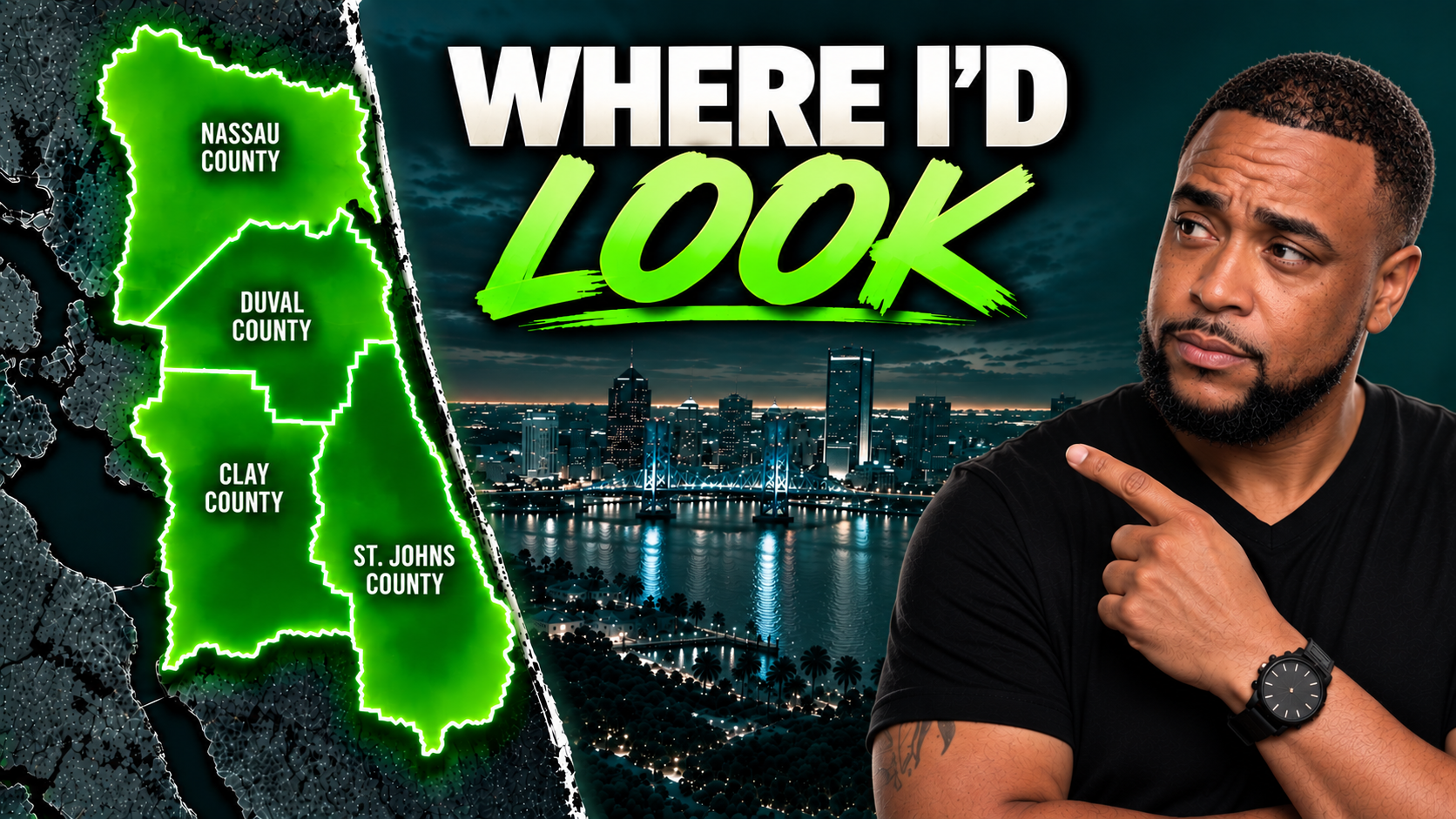
That's by design. Builders are very good at staging a feeling. If you're moving to Northeast Florida and touring new construction in Duval, St. Johns, Nassau or Clay County, the real question isn't whether the model is beautiful. It's what you're actually buying, what it really costs every month, and whether it still makes sense on the day you sell.
Adrian has walked through hundreds of model homes across the area. Before real estate, he worked in mortgages, framed houses and owned a roofing company, and he got his start on the investment side. Here's the checklist that runs through his head, in the order he walks it.
The short answer: look past the finishes. Check the roof and how the house is built, how far along the community is, what's on the real site map, which amenities are actually open, the HOA and CDD, how the floor plan works day to day, what's standard versus an upgrade, the full monthly payment, and how long you plan to stay. The kitchen is what the builder wants you to see. Everything else decides whether it's a good buy.
Why look at the roof before the kitchen?
Because the first thing worth checking is outside. Most buyers look at the front elevation. We look up at the roof.
- Shingle type.
Is it a 3-tab shingle or an architectural shingle? That makes a real difference in how long the roof lasts.
- Roof shape.
Every valley, every angle and every change in the roofline adds complexity. A beautiful, complicated roof is also one somebody gets to replace in about 20 years.
None of this replaces an inspection. We believe in getting a qualified home inspector on a new construction home, even one finished yesterday. New doesn't automatically mean perfect. Knowing how houses go together just helps you ask better questions.
What should you check about the community before you buy?
How far along it is, what's coming next door and what you'll pay for amenities. Some new communities look like resorts, the kind where you almost expect a front desk. Before getting excited about the entrance and the clubhouse, find out exactly what you're buying into.
- How far along is it?
Buy early and you usually get your pick of lots and floor plans, along with life in a construction zone: dump trucks at 7 in the morning, dust on everything and the occasional nail in a tire. Buy near the end and most of that is behind you. The trees are filling in, the amenities are open and you can see what the neighborhood will be, with fewer choices left.
- The real site map.
Not the marketing brochure. Where are the future phases? Is commercial coming? Apartments? A future road looks like a thin line on a site map, and it's a whole lot louder in person.
- Amenities that are open versus planned.
There's a big difference between swimming in a pool and looking at a picture of a pool.
- HOA and CDD.
If the community has an HOA or a CDD, you pay it whether that pool is finished or not.
Which stage fits you depends on how long you plan to stay, and we'll come back to that.
How do you know if a floor plan actually works?
By how much of the space you'd actually use, not the square footage on the sign. "This house is 2,800 square feet!" Great, but some homes have so many hallways you need GPS to find the kitchen, and some smaller homes feel twice as functional.
Ask 1 simple question in the living room: where does the TV go? If 1 wall is all windows, another is the sliding glass door and the third opens to the kitchen, the only spot left is up near the ceiling. Now you're watching the evening news like you're in the front row of a movie theater.
Then ask about the things you can't see:
- What HVAC system comes with the house?
- What insulation is in the attic?
- What kind of windows are going in?
Here in Florida we deal with heat, humidity, heavy rain and the occasional storm that reminds everyone they own a flashlight. You don't need to become a construction expert. You just need to know which questions to ask, because the prettiest things in a house are often the least important things to evaluate.
What's standard and what's an upgrade in a model home?
Usually far less is standard than the model makes it look. Builders know how to make a house shine: high ceilings, perfect lighting and a kitchen island you could land a helicopter on. Then you see an advertised price of, say, $400,000 and think that's not bad at all.
Hold on. The house you're standing in may not be the house you get for that price. That kitchen? Upgrade. Cabinets all the way to the ceiling? Upgrade. The flooring? Upgrade. The fancy lighting? You guessed it. By the time it all adds up, the price can climb a long way past the number on the sign.
So find out what the house you're actually buying includes:
- What's standard?
- What's an upgrade?
- What can you add later?
- What has to be decided before they pour the slab?
And be careful in the design center. It's an adult candy store. You walk in to pick out some cabinets and flooring, and 3 hours later you're trying to figure out how you just spent another $35,000.
We're not saying don't upgrade. If this is your forever home, that's a different conversation. But an upgrade that costs you $20,000 doesn't mean the next buyer pays you $20,000 more when you sell. That's not how resale works.
Before you fall for a room, picture living in it: backpacks dropped by the door, groceries spread across the counter, a slow Saturday morning with everybody home. That's when you find out whether the floor plan really works.
Plan Your Jacksonville Move Around Your Lifestyle
Get help matching the right neighborhood, budget, commute and social lifestyle before you make a move.
Schedule a Consultation
How much house should you buy?
Less than the most a lender will approve, in most cases. There's a difference between what you qualify for and what you actually want to spend every month. Being approved for a $650,000 house doesn't mean you need a $650,000 house. You still have a life to live: vacations, hobbies, maybe a boat. The mortgage company doesn't know how much you love to fish.
Look at the whole monthly picture, not just the price on the sign:
- The mortgage payment
- Property taxes
- Homeowners insurance
- An HOA, if there is one
- A CDD, if there is one, including how much it is and how long it runs
2 homes at almost the identical price can come with very different monthly bills. We walk through how those costs stack up on a real example in what new construction in Jacksonville really costs.
Are builder incentives worth it?
They can be, once you know the details. Some promotions are fantastic. The question is whether the rate is fixed for the life of the loan or a temporary buydown where the payment goes up later. You don't want to get comfortable with a payment you can't afford once the buydown ends.
Look at the builder's inventory too. How many finished homes are sitting there, and for how long? A quick move-in home usually gives you more leverage on price than one that hasn't even been started.
Can you negotiate with builders on a new construction home?
Yes, but usually not by $50,000. Here's the question we hear all the time: "Can we offer $450,000 on that $500,000 house?" You can ask. We just wouldn't start spending that $50,000 yet.
Most builders are very protective of their pricing, and there's a reason. If they sell a $500,000 house for $450,000, the next buyer sees that someone got $50,000 off the same floor plan, and now everybody wants that price.
That doesn't mean nothing is negotiable. With some builders there may be room for $5,000, $10,000, sometimes $15,000 off the price. Where there's usually more room is the incentives:
- More help with closing costs
- A rate buydown
- Certain upgrades included
Those can be worth more to you than a small price cut. And on new construction, our job isn't to win a big negotiation. It's to make sure you get everything the builder promised: the upgrades you picked are the upgrades that get installed, the incentive on paper is the incentive at closing, and the house you were sold is the house you move into.
So don't walk away from a house that checks every box because somebody convinced you your agent should have gotten $50,000 off. We're buying a house, not haggling over a refrigerator on Facebook Marketplace.
Should you buy the house you love or the house that makes sense?
It depends on how long you'll live there. If it's your forever home, your lifestyle, your comfort and what makes you happy carry a lot more weight. If you plan to stay 3 to 5 years, it's a completely different conversation.
For a shorter stay, look hard at the location, the floor plan, the builder and how many homes are still left to build. If the builder is still selling 3 years from now, the house you're up against when you sell could be your exact floor plan, brand new, with a warranty and a rate buydown you can't match. We covered what that looks like for today's sellers in why Jacksonville sellers are asking less. There's no guarantee a home goes up in value in 3 to 5 years, and even if it rises a little, the cost of owning and the cost of selling can eat right through that gain.
Picture 2 houses. One has the most beautiful kitchen you've ever seen. The other has a smaller kitchen, but it's in a more established community, the floor plan works better for your household and the numbers make more sense.
- Staying 25 years?
Maybe the first house is exactly what you've always wanted. You'll be cooking in that kitchen for a long, long time, and spread over that many years, the kitchen money is well spent.
- Staying 4 years?
Take a real close look at the second house. The trees are already grown in, the pool is open, nobody's pouring concrete next door, and the floor plan works on an ordinary weeknight, not just on the day you tour it.
Our take
If you called us about a model home you'd fallen for, we'd ask about everything the brochure leaves out: the community around it, how it's built, the real monthly payment and how long you plan to call it home. The kitchen is the part the builder wants you to see. Those 4 things decide whether it's a good buy. Then we'd make sure that what you're promised on paper is what you get at closing.
Every price in this post is an example, not any builder's actual pricing. This is education, not a forecast.
If you're thinking about relocating to Jacksonville or anywhere in Northeast Florida, or you're ready to buy or sell a home, we'd love the opportunity to help.
Our team specializes in making the entire process as smooth and stress-free as possible, whether you're moving from across the country or just across town.
Give us a call, send us a text, or schedule a Zoom consultation, and let's create a game plan that's built around your goals.
Schedule a Meeting
Call or text 904-414-2274
or email info@drrealestatejax.com